
핵심 요약
- AI changed the cost of rewriting application code, not the cost of moving durable state. The data layer is where control actually persists.
- A closed data platform makes your roadmap, pricing, and deployment options someone else’s decision, and the deeper the integration, the harder that is to reverse.
- Open source is not only protection from lock-in. It is a place to build advantage.
- Kimi, Pinterest, Atlassian, and Dify run production workloads on TiDB, which shows openness and scale are not a tradeoff.
For most of the cloud era, infrastructure decisions followed a familiar pattern: choose the fastest path to production, accept some proprietary dependencies, and optimize later. AI breaks that pattern. Coding agents now reshape applications in hours, while models, frameworks, and workload shapes change underneath them.
That leaves the data layer as the one place a company cannot afford to surrender control. Everything above it is cheap to rewrite. Durable state is not. This is the case for an open source data layer: it preserves optionality at the layer where optionality matters most.
Your Data Layer is Your Control Plane
Models, application frameworks, and dominant agent architecture will change. The durable state of an AI application stays put: customer context, permissions, transactions, embeddings, conversation history, workflow state, and operational telemetry all live in the data layer.
That makes the database more than infrastructure. It is the control plane for the application’s memory and behavior.
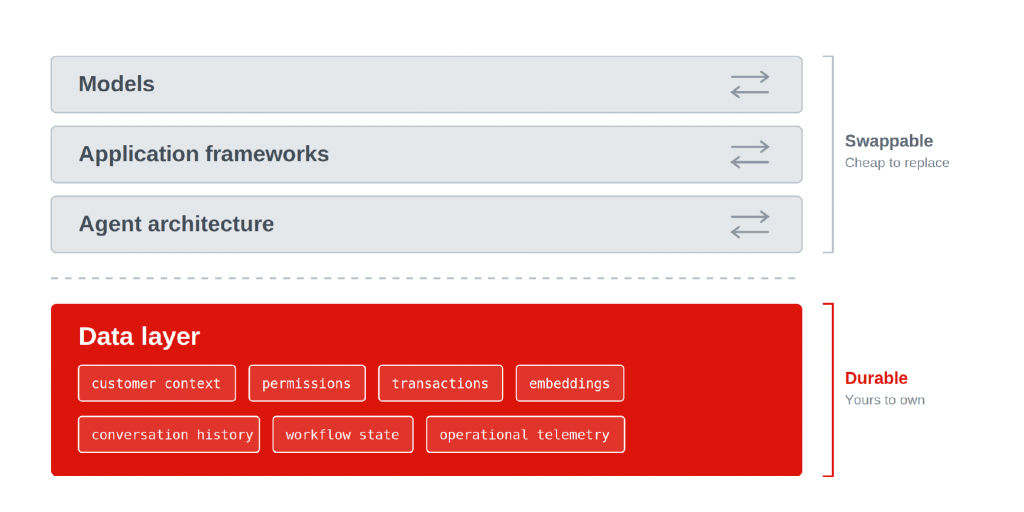
Figure 1. Everything above the data layer is now cheap to replace. The state inside it is not.
A closed data platform puts that control plane behind boundaries one vendor defines. You inherit its roadmap, pricing, deployment constraints, and architectural assumptions. When your business needs something the vendor does not support, you wait, escalate through a support contract, or redesign around the limitation. You cannot fix the problem yourself, and you cannot take the technology somewhere the vendor has not prioritized. The deeper the integration, the less control you keep.
Why an Open Source Data Layer Shifts the Balance of Power
An open source data layer does not eliminate switching costs. It converts a hard dependency into a choice. You can read the implementation, run it yourself, move it between environments, influence its direction, or pick a different provider, and none of those options require the vendor’s permission.
Diagnose and Extend Without Waiting on a Roadmap
You can also shape the data layer around requirements specific to your business. Your engineers can add a capability, optimize a hot access pattern, or remove a bottleneck instead of filing a feature request. As AI drives up demand for scarce compute, workload-specific optimizations that cut CPU, storage, or data movement show up directly in margins.
Debugging changes too. When something breaks, diagnosis does not stop at the vendor boundary. Your engineers can trace the failing path, reproduce the behavior, ship a workaround, or prepare a patch without waiting in a support queue. Commercial support still matters, but it becomes an accelerator rather than the only route to an answer.
Those improvements compound into proprietary know-how built on an open foundation: a faster product, a lower cost structure, or a capability competitors cannot copy quickly. Open source is not only protection from lock-in. It is a place to build advantage.
Coding Agents Make Openness More Valuable
Coding agents raise the return on open systems. An agent can trace behavior through a codebase, diagnose an incompatibility, generate a migration tool, propose an optimization, or build a missing integration. Every visible interface, test, issue, and implementation detail becomes usable context for both engineers and their agents.
Closed systems expose only what the vendor chooses to document. Open systems expose the machinery. As software creation gets more automated, the right to inspect and modify every layer of the stack gets more valuable, not less.
AI Workloads Refuse to Stay in One Box
An AI application usually starts with a relational schema or file system. Within months it needs chat history, tenant isolation, full-text and vector search, workflow state, analytics, and fast-growing operational data. Agents generate bursty, concurrent, stateful workloads that are difficult to forecast.
The data layer has to scale across users, transactions, data types, regions, and access patterns without forcing a rebuild of the application. Licensing alone does not deliver that. Architecture does.
TiDB: An Open Source Data Layer Without a Ceiling
티DB is an open-source distributed SQL database: a horizontally scalable system that speaks SQL and preserves ACID transactions across nodes. It presents a MySQL-compatible interface and supports hybrid transactional and analytical processing (HTAP), allowing transactional and analytical queries to run against the same data in one system.
TiDB Cloud also provides an agent-friendly file system API, giving agents two ways to work with the same data: through SQL or through familiar file system operations. This combines the accessibility of a file system with the structure, consistency, and querying power of a relational database. Agents can navigate and manipulate data through a natural file-oriented interface without giving up the guarantees and capabilities of the underlying database.
The stateless SQL layer scales independently of storage. TiKV replicates data across storage nodes using Raft consensus and handles failover automatically. TiFlash provides columnar analytical reads over the same data, while PD manages placement and scheduling. The TiDB architecture documentation explains how these components work together.
That combination is the point. Openness without operational maturity does not survive production, while scale without portability merely recreates lock-in in another form. TiDB gives organizations the freedom to run and modify the technology on their own terms, backed by an architecture designed to grow without repeated application rewrites. Its MySQL compatibility gives developers and coding agents a surface they already understand, while its file system API makes the same database even more natural for agents to access and use.
What Production Deployments Show
The argument has moved from theory to production. Four companies with four different scaling problems, AI-native hosting, established internet scale, extreme multi-tenancy, and a fragmented stack, converged on the same open source data layer. Their published results:
| 회사 | Problem | TiDB Results |
|---|---|---|
| Kimi (Moonshot AI) | Kimi’s AI Agent Platform turns a prompt into a live hosted application, creating a database requirement for every generated site | Sub-1-second database provisioning, zero per-site compute cost at idle, tens of millions of concurrent tenant sites on one cluster |
| Legacy graph service split across HBase and MySQL, application-level indexing, a decade of technical debt | Rebuilt as PinGraph on TiDB: up to 10x lower p99 latency, more than 50% lower infrastructure cost, no manual sharding | |
| 아틀라시안 | Millions of Forge tenants, metadata explosion, a sprawling sharded PostgreSQL estate | 750+ PostgreSQL clusters consolidated into 16 global clusters, 3M+ tables in one system, 500K validated concurrent active connections per cluster |
| Dify | Nearly half a million isolated database containers spanning vectors, documents, chat history, and relational data | One unified system, 80% lower infrastructure cost, 90% less operational overhead |
Pinterest named TiDB’s open source licensing as part of its selection criteria. Manus migrated to TiDB Cloud in roughly two weeks and now runs agent context persistence on it. Plaud replaced MySQL and Amazon S3 with TiDB Cloud, removing the application-layer coordination between transcript blobs and metadata. The pattern across all of them is the same: the workload outgrew the architecture, and the ability to inspect and reshape the data layer shortened the path to a fix.
Managed Convenience and Open Source Control Can Coexist
An open source data layer does not obligate you to operate your own database. Managed services deliver real value through automation, reliability, security, and support. The question is what stays possible when your requirements change.
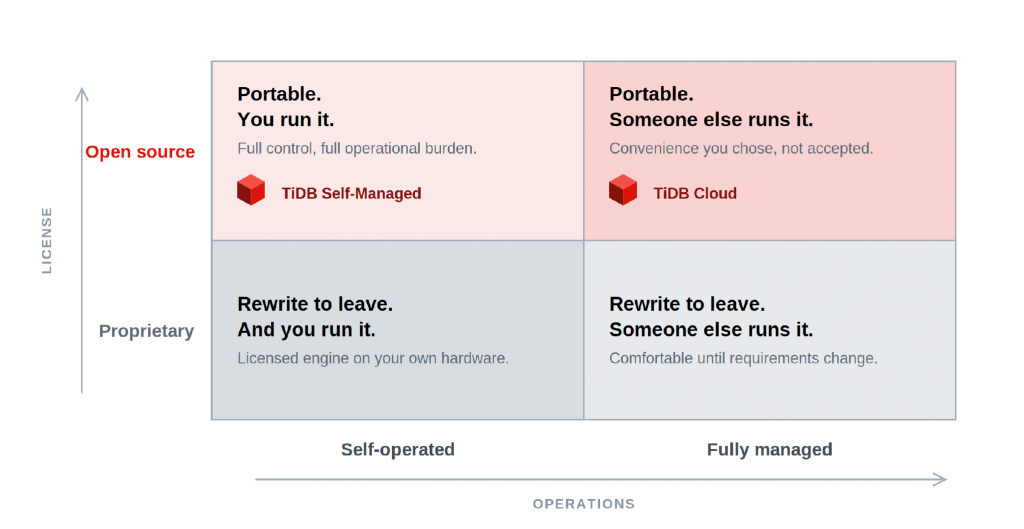
Figure 2. Managed and open are separate axes. Only one of them determines whether you can leave.
Can you deploy elsewhere, read the core system, avoid proprietary interfaces, or bring operations in-house? On an open source foundation, a managed service is a choice you make for value, not a condition you accept because leaving is impractical. The AI era needs convenience without captivity.
Own the Layer That Remembers
Most companies will not own the models they use, the clouds those models run on, or much of the code their agents generate. They do need to own the layer that remembers their customers, transactions, decisions, permissions, and context.
Open source protects that ownership. The companies that win the AI era will move quickly while keeping the freedom to change direction, and that freedom starts with the data layer.
Owning the data layer means knowing what it has to do. Explore our breakdown of the context platform pattern: one SQL interface across vectors and structured rows, transactional and analytical reads that stay fresh against each other, and compute that absorbs agent bursts.
Spin up a database with 25 GiB free resources.
TiDB Cloud 전용
예측 가능한 워크로드를 위한 완전 관리형 클라우드 DBaaS
TiDB Cloud 스타터
워크로드 자동 확장을 위한 완전 관리형 클라우드 DBaaS