Overview

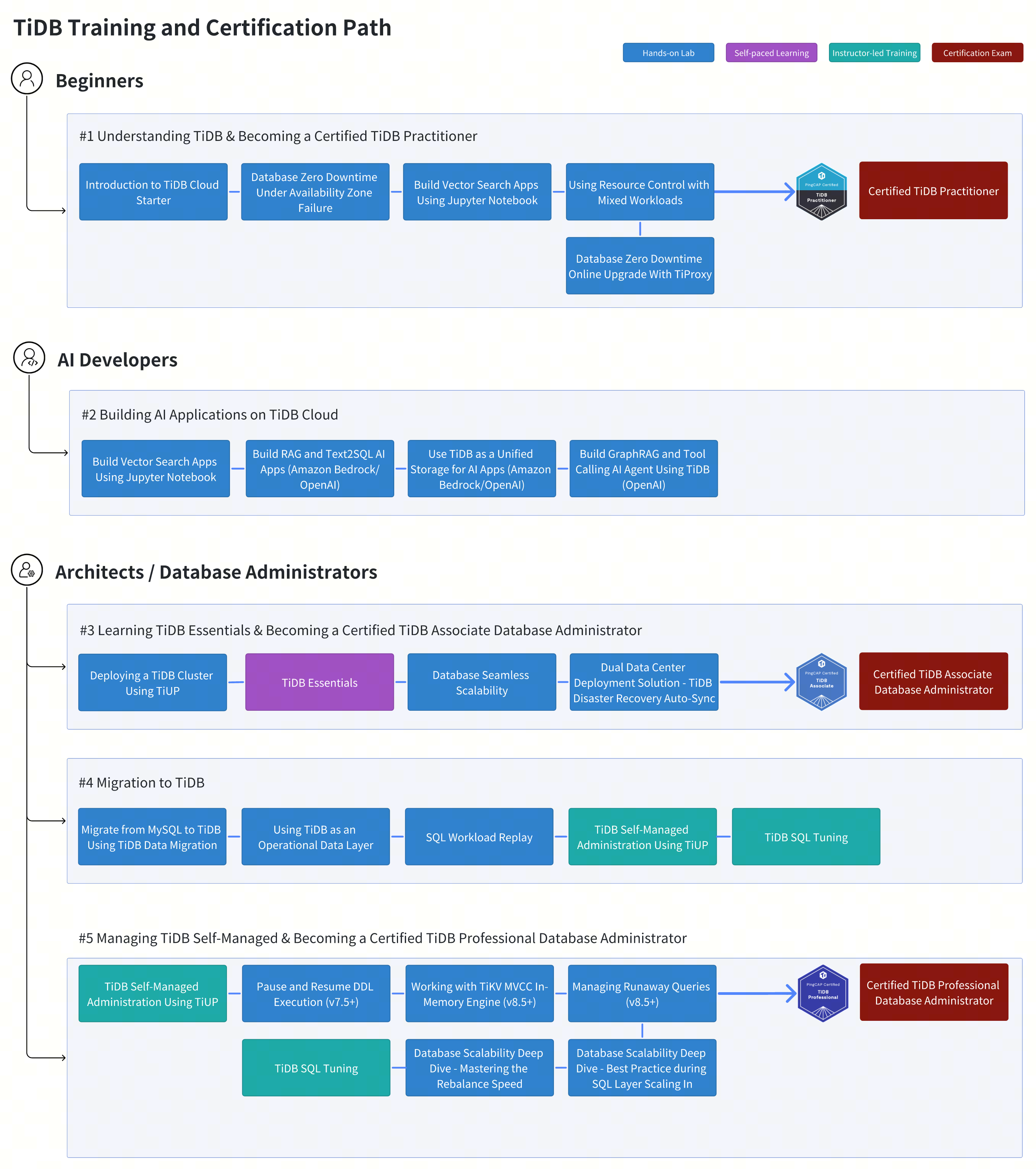
PingCAP offers interactive hands-on labs, self-paced courses, and professional instructor-led training classes to help users get ramped up quickly on TiDB and TiDB Cloud. Architects, backend developers, AI developers, database administrators and operations professionals can benefit from the training program and demonstrate their expertise by earning a globally recognized certification. 

Note: 

  1. All the hands-on lab resources are available at the TiDB Hand-on Lab Platform.
  2. All the self-paced learning and certification resources are available at the TiDB Training and Certification Platform.
  3. Instructor-led training includes public training class and private training class, and can be delivered remotely or in person.  

Beginner – TiDB Practitioner Learning Path

Learn TiDB fundamentals through a self-paced course and hands-on labs, covering architecture, HTAP capabilities, zero downtime, and culminating in a free certification exam.

Training and CertificationDurationContent TypeGet Started
Course – Introduction to TiDB90 minutesSelf-paced online learningSee details
Lab – Introduction to TiDB Cloud Starter150 minutesHands-on LabStart lab
Lab – Database Zero Downtime Under AZ Failure60 minutesHands-on LabStart lab
Exam – TiDB Practitioner50 minutesOnline proctoredSee details

Generative AI Learning Path

Build AI applications using TiDB Cloud as a unified storage layer, mastering Retrieval-Augmented Generation and Text-to-SQL with hands-on labs featuring Amazon Bedrock and OpenAI.

Training and CertificationDurationContent TypeGet Started
Lab – Build Vector Search Applications Using Jupyter Notebook120 minutesHands-on LabStart lab
Lab – Build RAG and Text2SQL AI Apps (Amazon Bedrock)120 minutesHands-on LabStart lab
Lab – Use TiDB as a Unified Storage for AI Apps (Amazon Bedrock)120 minutesHands-on LabStart lab
Lab – Build RAG and Text2SQL AI Apps (OpenAI)120 minutesHands-on LabStart lab
Lab – Use TiDB as a Unified Storage for AI Apps (OpenAI)120 minutesHands-on LabStart lab
Lab – Build GraphRAG and Tool Calling AI Agent Using TiDB (OpenAI)120 minutesHands-on LabStart lab

Developer – TiDB Certified SQL Developer Learning Path

Develop applications on TiDB and achieve certification as a TiDB SQL Developer through hands-on labs and instructor-led training resources.

Training and CertificationDurationContent TypeGet Started
Course – Introduction to TiDB90 minutesSelf-paced online learningSee details
Lab – Introduction to TiDB Cloud Starter150 minutesHands-on LabStart lab
Lab – Working with TiDB Cloud Using mysql-connector-python120 minutesHands-on LabStart lab
Lab – Working with TiDB Cloud Using JDBC120 minutesHands-on LabStart lab
Course – Working with TiDB Cloud from PHP180 minutesSelf-paced online learningSee details
Course – TiDB SQL Tuning2 daysInstructor-led trainingSee details
Exam – TiDB SQL Developer90 minutesOnline proctoredSee details

Architect & DBA – TiDB Certified Associate Learning Path

Explore TiDB essentials and best practices, preparing for certification as a TiDB Associate through comprehensive training modules.

Training and CertificationDurationContent TypeGet Started
Course – TiDB Essentials1 daySelf-paced online learningSee details
Lab – Deploying a TiDB Cluster Using TiUP60 minutesHands-on LabStart lab
Lab – Database Seamless Scalability90 minutesHands-on LabStart lab
Lab – Dual Data Center Deployment Solution – TiDB Disaster Recovery Auto-Sync100 minutesHands-on LabStart lab
Exam – TiDB Associate Database Administrator80 minutesOnline proctoredSee details

Architect & DBA – Migration to TiDB Learning Path

Understand the migration process to TiDB, equipping yourself with skills to transition databases smoothly and efficiently.

Training and CertificationDurationContent TypeGet Started
Lab – Migrate from MySQL to TiDB Using TiDB Data Migration60 minutesHands-on LabStart lab
Lab – Using TiDB as an Operational Data Layer60 minutesHands-on LabStart lab
Lab – SQL Workload Replay90 minutesHands-on LabStart lab
Course – TiDB Self-Managed Administration Using TiUP2 daysInstructor-led trainingSee details

DBA – TiDB Certified Professional Learning Path

Become proficient in managing self-managed TiDB instances, leading to certification as a TiDB Professional Database Administrator.

Training and CertificationDurationContent TypeGet Started
Course – TiDB Self-Managed Administration Using TiUP2 daysInstructor-led trainingSee details
Lab – Pause and Resume DDL Execution (v7.5+)45 minutesHands-on LabStart lab
Lab – Working with TiKV MVCC In-Memory Engine (v8.5+)60 minutesHands-on LabStart lab
Lab – Managing Runaway Queries (v8.5+)90 minutesHands-on LabStart Lab
Lab – Database Scalability Deep Dive – Mastering the Rebalance Speed60 minutesHands-on LabStart Lab
Lab – Database Scalability Deep Dive – Best Practice during SQL Layer Scaling In90 minutesHands-on LabStart Lab
Exam – TiDB Professional Database Administrator80 minutesOnline proctoredSee details

Appendix

1. Course – Introduction to TiDB

This course introduces the core components and their concepts to build up the distributed TiDB cluster and TiDB Cloud.

Course Overview
  • Audience: Architects, Developers and DBAs
  • Level: Introductory
  • Duration: 90 minutes
  • Prerequisites: None
Free, on-demand videos and exercises available. Start free learning
Course Outline
  • The Reasons for Choosing TiDB
  • TiDB Overall Architecture
  • The SQL Layer – A Distributed MySQL
  • The Storage Layer – A Distributed Key-Value Store
  • The Translytical Platform – TiDB HTAP
  • TiDB Cloud Introduction
  • Real-World User Cases

2. Course – TiDB Essentials

This course focuses on the architecture and design principles of TiDB, which is the basis for administration, development, performance tuning and troubleshooting.

Course Overview
  • Audience: Architects, Developers and DBAs
  • Level: Intermediate
  • Duration: 1 day
  • Prerequisites: Basic computer, operating system, network and database knowledge; Ability to read simple SQL statements.
Free, on-demand videos and exercises available. Start free learning
Course Outline

01: TiDB Database Architecture Overview

  • TiDB Database Architecture Overview
    • Understand the overall architecture of TiDB
    • Describe the key features of TiDB server, TiKV server, and Placement Driver (PD) server
  • TiDB Server
    • Describe TiDB server’s architecture
    • Describe TiDB server’s role in TiDB cluster
    • Describe TiDB server’s processes
    • Describe TiDB server’s server cache
  • TiKV Server
    • Understand TiKV server’s architecture
    • Describe the data persistence and read operations in TiKV
    • Understand how TiKV cluster provides MVCC and distributed transaction support
    • Understand the distributed consistency based on the Raft algorithm
    • Understand TiKV server’s Coprocessor
    • Placement Driver Server
    • Understand PD server’s architecture and features
    • Understand TSO (Timestamp Oracle) concept and its purpose
    • Understand scheduling process
    • Understand the relationship between labels and high availability
  • TiDB SQL Execution Process
    • Describe the process of reading and writing data with DML
    • Describe the execution flow of DDL

02:  TiDB HTAP

  • HTAP Overview
    • Understand HTAP (Hybrid Transactional/Analytical Processing) technology
    • Understand the HTAP architecture of TiDB database
    • Understand the HTAP core functions of the TiDB database
  • TiFlash Overview
    • Describe the architecture of TiFlash
    • Understand the main functions of TiFlash

03: New Features in TiDB v6.0

  • Understand Placement Rules in SQL
  • Describe small table cache
  • Understand in-memory pessimistic lock
  • Understand Top SQL

04: New Features in TiDB 8.1 and 8.5

  • Understand TiKV MVCC in-memory engine
  • Understand foreign keys
  • Understand global index for partitioned tables
  • Understand monitoring indexes usage statistics
  • Understand TiProxy
  • Understand Vector Search

05: TiDB Cloud

  • Describe why you should consider the “The Cloud”
  • Describe TiDB Cloud account types
  • Compare and contrast TiDB and TiDB Cloud
  • Get you to create a TiDB Cloud account and try it

3. Course – TiDB Self-Managed Administration Using TiUP

This course guides you learn about managing TiDB Self-Managed, backup and restore strategies, as well as the scenarios and common usage of some ecosystem tools.

Course Overview
  • Audience: Database administrators
  • Level: Intermediate
  • Duration: 2 days
  • Prerequisites: You have completed TiDB Essentials, or you should be familiar with distributed database operation and administer or equivalent work experience.
Public training available.   Check the public training schedule and purchase a seat.
Private training available.   To purchase a private training, please speak to your PingCAP representative or contact sales.
Course Outline

01: TiDB Cluster Deployment

  • Describe TiUP
  • Understand how to deploy a TiDB Cluster
  • Understand how to connect to TiDB

02: Connecting to TiDB

  • Understand the scope of TiDB system variables
  • Understand TiDB configuration file parameters
  • Describe how to modify TiDB system variables
  • Describe how to modify TiDB configuration file parameters

03: Security and User Management

  • Understand authentication and authorization
  • Understand the levels of access privileges for users
  • Manage TiDB user accounts
  • Grant and revoke privileges
  • Use SQL statements to manage accounts

04: Maintaining a TiDB cluster

  • Understand how to scale out and scale in TiDB cluster components
  • Understand how to clean up and Delete a TiDB cluster
  • Understand the timezone in TiDB
  • Describe placement rule
  • Understand how to upgrade a TiDB cluster
  • Understand how to monitor a TiDB cluster

05: Resource Control

  • Describe what resource control is
  • Understand the decision logic of resource control
  • Discuss the usage scenarios of resource control
  • Explain how to use resource control
  • Understand a real-world use case of resource control

06: Backup Terminology and Strategies

  • Describe TiDB backup types
  • Compare the various backup techniques

07: Importing Data using TiDB Lightning

  • Describe what TiDB Lightning is
  • Explain when and how to use TiDB Lightning
  • Using TiDB Lightning to import data

08: Exporting Data using Dumpling

  • Explain when and how to use Dumpling
  • Use Dumpling to perform logical backups

09: Backup and Restore

  • Describe what BR is
  • Explain when and how to use BR
  • Using BR to backup and restore TiDB cluster data
  • Understand point-in-time recovery (PITR)
  • Understand how to recover from data loss

10: Using sync-diff-inspector to Validate Data

  • Describe the key features of sync-diff-inspector
  • Explain when and how to use sync-diff-inspector
  • Using sync-diff-inspector to compare schema and data

11: Migrating Data from MySQL-compatible Databases with TiDB Data Migration (DM)

  • Describe the key features of TiDB Data Migration
  • Explain when and how to use TiDB Data Migration
  • Replicate data from MySQL-compatible upstream by using TiDB Data Migration cluster

12: Replicating TiDB Change Events Using TiCDC

  • Describe the key features of TiCDC cluster
  • Explain when and how to use TiCDC cluster
  • Using TiCDC cluster to fan out database change events to downstreams

4. Course – TiDB SQL Tuning

This course provides in-depth knowledge and practical skills to optimize SQL performance in TiDB. You will learn to design effective table and index structures, manage partitioned tables, and understand the SQL optimization processes.

Course Overview
  • Audience: SQL developers or DBAs
  • Level: Intermediate
  • Duration: 2 days
  • Prerequisites: A good working knowledge and understanding of SQL statements is assumed. Completing the TiDB training courses, Introduction to TiDB is recommended.
Public training available.   Check the public training schedule and purchase a seat.
Private training available.   To purchase a private training, please speak to your PingCAP representative or contact sales.
Course Outline

01: Clustered and Non-Clustered Indexes Considerations for Performance

  • Understand the primary key and the underlying indexes in TiDB
  • Describe the query (SELECT) process
  • Describe the data modification (INSERT / UPDATE / DELETE) process
  • Describe the TiKV Region split process
  • Performance tune common TiKV Region hotspots issues

02: Secondary Indexes and Partitioned Tables

  • Understand and create secondary indexes
  • Understand the table partition types
  • Create partitioned tables
  • Modify  partitioned tables
  • Describe the best practices with partitioned tables

03: Optimizer Fundamentals

  • Describe each phase of SQL statements processing
  • Explain the functionality of the optimizer
  • Explain the various phases of optimization
  • Display execution plans
  • Monitor SQL statements

04: Optimizing Queries

  • Describe the operators and data aggregators for tables and indexes
  • List the possible access paths for tables and indexes
  • Use indexes to improve query performance
  • Describe the aggregation function operators
  • Describe the operators for joins
  • List the possible access paths for joins
  • Describe the TiFlash MPP architecture
  • Use TiFlash to improve query performance

05: Cost Based Optimizer (CBO) Statistics Management

  • Explain how CBO statistics works
  • Understand the fundamental components of statistics
  • Display CBO statistics
  • Gather CBO statistics
  • Import and export statistics
  • Use dynamic pruning to optimize queries for partitioned tables

06: Best Practices for SQL Tuning in TiDB

  • Control execution plans with optimizer hints
  • Control execution plans with SQL Plan Management (SPM)
  • Understand the best practices for  using indexes and writing effective SQL

5. Course – Working with TiDB Cloud from PHP

This course guides you through a series of concepts and hands-on best practices to implement read and write operations via PHP. Two APIs are introduced: mysqli and PDO_MySQL.

Course Overview
  • Audience: SQL and PHP developers
  • Level: Introductory
  • Duration: 180 minutes
  • Prerequisites: Experience with PHP programming and SQL
Free, on-demand videos and exercises available. Start free learning
Course Outline

01: Using Database Connector

  • Explain what a database connector is
  • Describe TiDB Connector
  • Access TiDB via PHP
  • Describe the benefits of connection pooling
  • Handle NULL values in the result set

02: Using Prepared Statements

  • Describe the reasons for using prepared statement and its limitations
  • Use MySQL Client to execute PREPARE, EXECUTE, and DEALLOCATE on prepared statement
  • Describe the execution plan cache
  • Use prepared statement in your program

03: Exception Handling

  • Set SQL mode to modify the behavior of error output
  • Use SHOW WARNINGS and SHOW ERRORS
  • Interpret error messages
  • Handle exceptions in PHP

6. Exam – TiDB Practitioner

Becoming a certified TiDB Practitioner demonstrates your understanding of the TiDB’s basic concepts, terminology, and use cases. It is an entry-level certification designed for anyone who is interested in TiDB, even if you have little experience with TiDB or database technologies. This beginner-friendly, absolutely free certification can be retaken as many times as necessary until you succeed. It is a good starting point to pursue advanced TiDB certifications.

Exam Overview
  • Audience: Any roles
  • Prerequisites: None
  • Level: Foundational
  • Price: Free
  • Time Allotted: 50 minutes
Free, Online proctored exam available. Register Now!
Exam Outline
  • TiDB Basic Concepts and Terminologies
  • TiDB Core Components
  • TiDB Features for Analytical Workloads
  • TiDB Use Cases

7. Exam – TiDB Associate Database Administrator

This credential helps organizations identify and develop talent with critical skills for deploying, managing, and operating workloads on TiDB and TiDB Cloud. To earn this certification, you can either purchase a seat on the training and certification platform by yourself or speak to your PingCAP Sales representative directly.

Exam Overview
  • Audience: Database administrator
  • Prerequisites: None
  • Level: Associate
  • Price: $100 USD
  • Time Allotted: 80 minutes
Exam Outline
01: TiDB Database Architecture
  • Describe the TiDB database architecture overview
    • Describe the overall architecture of TiDB database
    • Identify the key features of TiDB Server, TiKV, and PD
      • Identify the TiDB Server features
      • Identify the PD features
      • Identify the TiKV features
      • Identify the TiFlash features
  • TiDB Server
    • Describe the TiDB Server architecture
    • Identify the functions of TiDB Server
      • Parse of SQL statements
      • Understand the modules related to SQL reads and writes
      • Understand the relational data and KV transformation
      • Online DDL
      • TiDB Server GC
    • Understand the memory control of TiDB
  • TiKV
    • Describe the architecture and features of TiKV
    • Understand the data persistence of TiKV
      • Identify Region features
      • Identify RocksDB features
      • Understand RocksDB writing process
      • Understand RocksDB query
    • Describe how TiKV provides MVCC and distributed transaction
    • MVCC
    • Distributed transactions
    • Understand the consistency of TiKV based on raft
      • Understand the Raft log replication
      • Understand the write to TiKV
      • Understand the read to TiKV
    • Coprocessor
 
  • PD(Placement Driver)
    • Describe the architecture and functions of PD
    • Understand the allocation of TSO
    • Understand the scheduling process
      • Scheduling: general process
      • Scheduling: information gathering
      • Scheduling: generating schedules
    • Understand the labels and high availability
    • Understand the Active PD Follower
  • High availability of TiDB
    • Understand the High availability characteristics of TiDB, TiKV, PD, TiFlash and TiProxy
    • Understand the High availability principle of TiDB base on Raft
    • Describe the deployment of three AZs
    • Understand the principle of DR Auto-Sync
  • TiDB Distributed eXecution Framework (DXF)
    • Describe the principle and functions of DXF
    • Understand how to use the DXF
  • TiDB Cloud
    • Describe the characters of different tiers of TiDB Cloud
    • Understand the architecture of different tiers of TiDB Cloud
02:  Data Consolidation of TiDB
  • Resource control
    • Understand the resource group
    • Understand the RU
    • Identify the functions of Resource control
    • Understand how to use the Resource control
  • Runaway Query
    • Understand the function of Runaway Query
    • Understand how to use Runaway Query
  • Placement Rules in SQL
    • Describe the principle and functions of Placement Rules in SQL
    • Understand how to use Placement Rules in SQL
03: Management of TiDB
  • TiProxy
    • Describe the architecture and functions of Tiproxy
    • Understand the function of Tiproxy
  • FLASHBACK CLUSTER
    • Describe the functions of FLASHBACK CLUSTER
  • Metadata locks
    • Describe the principle and functions of Metadata locks
    • Understand how to use Metadata locks
  • TTL
    • Describe the principle and functions of TTL
    • Understand how to use TTL
04: Performance Management of TiDB
  • Global memory control of TiDB
    • Describe the principle and functions of global memory control
  • TiKV MVCC In-Memory Engine
    • Describe the architecture and functions of the In-Memory Engine
    • Understand how to use TiKV MVCC In-Memory Engine
  • Acceleration of ADD INDEX and CREATE INDEX
    • Describe the principle and functions of Parallel DDL framework
  • Global Sort
    • Describe the architecture and functions of the Global Sort
    • Understand how to use Global Sort
  • Schema Cache
    • Describe the principle and functions of Schema Cache
    • Understand how to use Schema Cache
  • Follower Read and Stale Read
    • Describe the principle and functions of Follower Read and Stale Read
    • Understand how to use the Follower Read and Stale Read
  • Top SQL
    • Describe the functions of Top SQL
05: HTAP of TiDB
  • TiFlash
    • Describe the architecture and features of TiFlash
    • Understand the MPP architecture
  • Features of TiFlash
    • Use FastScan to accelerate queries in OLAP scenarios
    • TiFlash late materialization
    • TiFlash Query Result Materialization
    • Runtime Filter
    • TiFlash Disaggregated Storage and Compute Architecture and S3 Support

8. Exam – TiDB Professional Database Administrator

This credential is designed to validate candidates’ proficiency in TiDB’s principles, large-scale TiDB clusters management as well as TiDB tools, such as TiDB Lightning, TiDB Data Migration, TiCDC, sync-diff-inspector and troubleshooting skills. To earn this certification, you can either purchase a seat on the training and certification platform by yourself or speak to your PingCAP Sales representative directly.

Exam Overview
  • Audience: Database administrator
  • Objective: To validate candidates’ proficiency in TiDB’s principles, large-scale TiDB clusters management as well as TiDB tools
  • Prerequisites: You have to pass the TiDB Associate certification exam.
  • Level: Professional
  • Price: $240 USD
Exam Outline
01: TiDB Cluster Administration
  • TiDB Cluster Deployment
    • Use TiUP to deploy TiDB cluster
    • Create TiDB cluster in the TiDB Cloud
    • Configuration of Distributed eXecution Framework (DXF)
    • Configuration of DR Auto-Sync
  • Security and User Management
    • Understand authentication and authorization
    • Understand the levels of access privileges for users
    • Understand the authentication of TiDB
    • Understand the password management
  • TiProxy Administration
    • Deploy the TiProxy
    • Configuration of the TiProxy
  • Data Management
    • Understand the configuration of TTL
    • Understand how to use Placement Rules in SQL
  • DDL and Transaction Management
    • Understand how to Pause/Resume DDL
    • Understand the management of Metadata locks
  • Performance Management
    • Understand how to use Global memory control of TiDB
    • Configure and evaluate the TiKV MVCC In-Memory Engine
    • Understand how to create and setting Resource Group
    • Understand how to use RU
    • Understand how to use Resource Control
    • Understand how to use Runaway Query
    • Understand how to use SQL Prepared Execution Plan Cache
    • Understand how to acceleration of ADD INDEX and CREATE INDEX
    • Understand how to tuning performance on TiFlash
      • Use FastScan to accelerate queries in OLAP scenarios
      • TiFlash late materialization
      • TiFlash Query Result Materialization
      • Runtime Filter
      • TiFlash Disaggregated Storage and Compute Architecture and S3 Support
    • Understand how to TiDB Dashboard Cluster Diagnostics
02: TiDB Cluster Data Availability Management
  • Exporting Data
    • Explain when and how to use Dumpling
    • Use Dumpling to perform logical backups
  • Importing Data
    • Describe what TiDB Lightning is
    • Explain when and how to use TiDB Lightning
    • Understand fast import using the IMPORT INTO statement
    • Understand the LOAD DATA as Transaction
  • Using BR and PITR
    • Using BR for Backup and Restore
    • Explain when and how to use BR
    • Describe the principle and functions of PITR
    • Understand how to use PITR
  • FLASHBACK
    • Describe the principle and functions of FLASHBACK
    • Understand how to use FLASHBACK
    • Understand how to use FLASHBACK CLUSTER
03: TiDB Cluster Synchronizing and Data Migration
  • Migrating Data from MySQL-compatible Databases with TiDB Data Migration (DM)
    • Describe the key features of TiDB Data Migration
    • Explain when and how to use TiDB Data Migration
    • Replicate data from MySQL-compatible upstream by using TiDB Data Migration cluster
  • Replicating TiDB Change Events Using TiCDC
    • Describe the key features of TiCDC cluster
    • Explain when and how to use TiCDC cluster
    • Using TiCDC cluster to synchronize database change events to downstreams
  • Using sync-diff-inspector to Validate Data
    • Describe the key features of sync-diff-inspector
    • Explain when and how to use sync-diff-inspector
    • Using sync-diff-inspector to compare schema and data

9. Exam – TiDB SQL Developer

This credential is designed to assess the skills and knowledge of developers in using the unique features of TiDB, creating highly available and elastic applications with TiDB, and following best practices when working with the database. To earn this certification, you can either purchase a seat on the training and certification platform by yourself or speak to your PingCAP Sales representative directly.

Exam Overview
  • Audience: Developer
  • Objective: To assess the skills and knowledge of developers in using the unique features of TiDB, creating highly available and elastic applications with TiDB, and following best practices when working with the database.
  • Prerequisites: None
  • Level: Associate
Exam Outline
01: TiDB Architecture – 15% of exam
  • Describe the TiDB Cluster Architecture
  • Identify the TiDB Server Features
  • Identify the PD Features
  • Identify the TiKV Features
  • Identify the TiFlash Features
  • Describe what HTAP is
02: TiDB SQL Application – 30% of exam
  • Querying Data in TiDB
  • Data Types and Expressions
  • Functions and Expressions
  • Joins
  • Subqueries
03: TiDB Specific Features and Transaction Control – 30% of exam
  • Use AUTO_RANDOM
  • Use AUTO_INCREMENT
  • Use Placement Policy
  • Use Temporary Table
  • Use Cached Table
04: Best Practices for Developing on TiDB – 25% of exam
  • Understand Best Practices in Designing Tables
  • Understand Best Practices in Writing SQL


Last updated December 7, 2025