

Key Takeaways
- Stored procedures create deployment friction, version control drift, and observability gaps that worsen at scale.
- A service layer replaces them with testable, debuggable, independently scalable application code.
- Co-locating the service with the database preserves low latency while unlocking modern tooling and libraries.
- Migration can be incremental — start with new functionality and move existing procedures over as needed.
If you’ve worked with relational databases long enough, you’ve almost certainly encountered stored procedures. They made sense in an era when network latency was expensive and applications were monolithic, but the world has moved on. In this post, we’ll look at why stored procedures are holding teams back and what a modern alternative looks like.
What Are Stored Procedures?
Stored procedures are pieces of code that live inside the database itself, executed on demand via CALL statements, triggers, or scheduled events. In MySQL (and MySQL-compatible databases like TiDB), these are traditionally written in SQL/PSM, a procedural extension of the SQL standard.
MySQL’s commercial edition recently added JavaScript support for stored procedures, but the Community Edition — along with derivatives like AWS RDS — still only supports SQL/PSM. Other databases such as PostgreSQL offer multi-language support, but the fundamental tradeoffs remain the same.
Stored procedures have historically served two purposes: Acting as an abstraction layer so that multiple applications can share database logic without duplication, and reducing network roundtrips by bundling several SQL statements into a single server-side call.
Both are legitimate goals. But the way stored procedures achieve them introduces a long list of operational problems.
The Case Against Stored Procedures
Over time, stored procedures accumulate friction across nearly every dimension of the software development lifecycle:
- Deployment and version control. Teams deploy stored procedures separately from the application code that depends on them, adding coordination overhead to every release and rollback. Worse, the version running in production often doesn’t match what’s in version control — if it’s in version control at all.
- Language mismatch. Your application is written in Go, Java, or Python. Your stored procedures are written in SQL/PSM. This means constant context-switching, separate tooling, and a smaller talent pool for reviewing database-side code.
- Limited debugging, testing, and observability. Breakpoints? Rarely supported. Unit tests? Almost never done. Logging, metrics, and tracing? Stored procedures typically don’t integrate with any of it. The result is a growing body of untested, uninstrumented business logic hiding inside the database.
- Constrained functionality. Need to call an external API, use a third-party library, or send a notification? Stored procedures offer very limited support, which often leads to duplicated validation logic across the database and application layers.
- Weak tooling. IDE support for SQL/PSM lags far behind mainstream languages. Code completion, refactoring, linters, and static analysis are either missing or rudimentary.
- Performance and scalability limits. The database engine typically interprets stored procedures rather than compiling them, and they consume compute resources on the database server itself. In architectures with a single primary — common in MySQL deployments — this creates a scalability ceiling at exactly the wrong place.
A Modern Alternative to Stored Procedures: A Service Layer
The solution is straightforward: Replace stored procedures with a dedicated service layer that owns the database access and exposes an HTTP (or gRPC) API to other applications. Instead of calling stored procedures over a SQL connection, applications call the service over HTTP.
This unlocks several advantages at once:
- Standard development practices. Your database logic is now regular application code. It lives in version control, goes through code review, gets tested in CI, and deploys through the same pipeline as everything else. Debugging is just debugging.
- Language flexibility. Implement the service in whatever language makes the most sense — Go for performance, Python for rapid prototyping, or whatever your team already knows. You get full access to the language’s ecosystem of libraries, frameworks, and tooling.
- Better security and auditability. A service layer gives you a natural place to add authentication, authorization, request logging, and audit trails. This is significantly harder to achieve inside the database.
- Independent scalability. The service scales horizontally, separate from the database. You’re no longer constrained to the compute resources of a single database primary. This is especially powerful when paired with a distributed database like TiDB, where the storage layer already scales horizontally — now your application logic can too.
- Improved performance. Compiled, optimized application code running in its own process will generally outperform interpreted SQL/PSM executing inside the database engine.
- Reduced roundtrips, done right. One of the original motivations for stored procedures was batching multiple SQL operations into a single call. A service achieves the same thing. It sits close to the database and handles multi-step operations internally, exposing a single clean API call to the outside world.
Architecture: Where to Place the Service
The placement of your service relative to the database matters for latency.
When an application talks directly to a remote database, every SQL roundtrip crosses the network. If the application is close to the end user but far from the database, latency accumulates quickly across multiple queries.
A service layer solves this by co-locating with the database. The application makes a single HTTP call to the service, and the service handles all the SQL roundtrips over a fast local connection. The total end-to-end latency drops significantly.
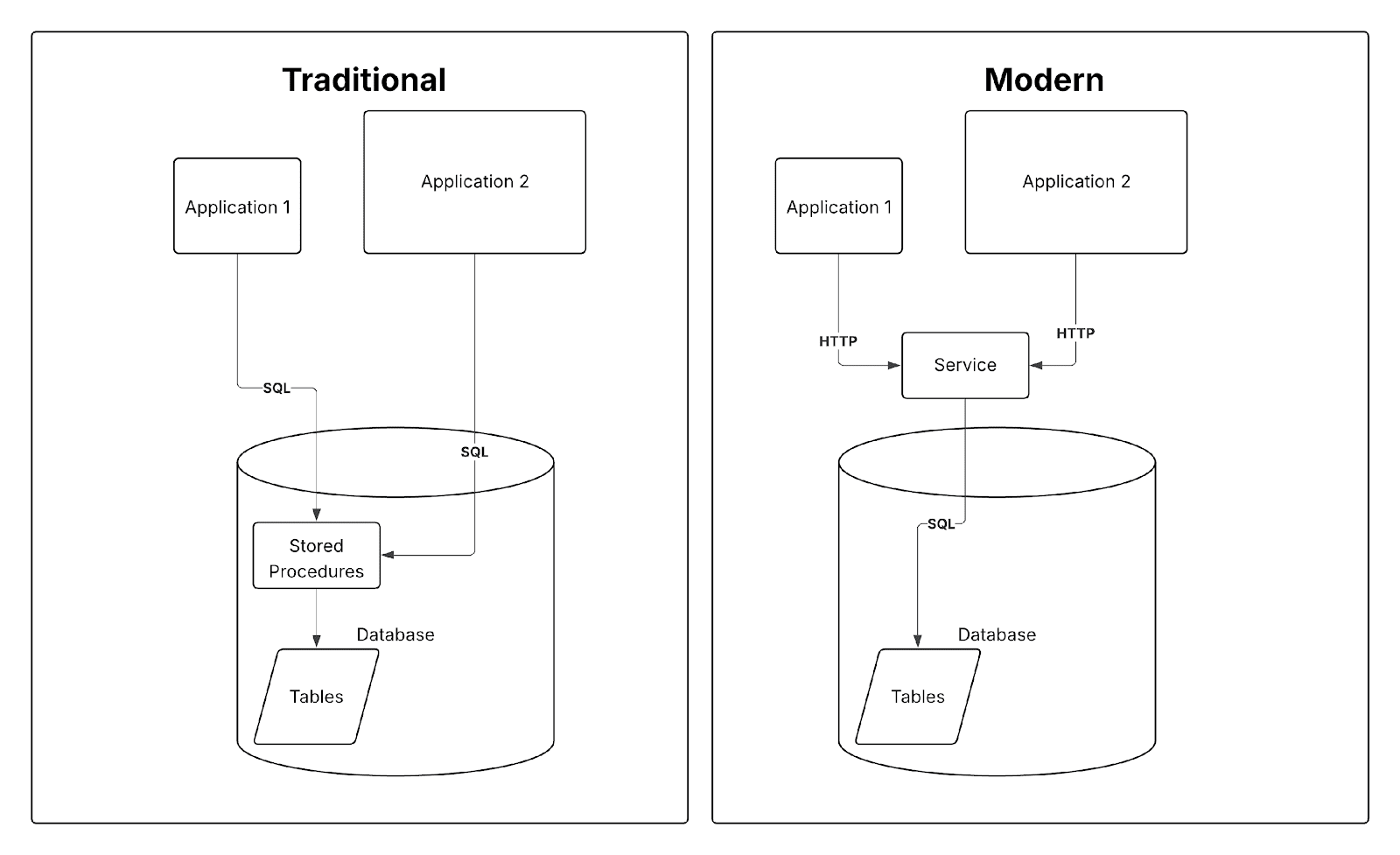
If a particular piece of logic is only consumed by one application, there’s an even simpler option: Just put the logic in that application. The service-layer pattern is most valuable when multiple consumers need to share the same database operations.
A Practical Example
Consider a bookstore application with the following operations implemented as stored procedures:
- An
isbn13_validfunction that checks whether a string is a valid ISBN-13 code. - An
add_bookprocedure that inserts a book after validating its ISBN. - A
set_priceprocedure that updates a book’s price. - A
sell_bookprocedure that adjusts inventory and records the sale. - A
books_jsonview that returns the catalog as JSON documents.
Migrated to a service, these become HTTP endpoints:
GET /api/v1/books— returns the catalog in JSON.POST /api/v1/buy— processes a sale, updating inventory and recording the transaction.
And the migration opens up possibilities that stored procedures simply couldn’t support. The ISBN validation, for example, could use a proper library (like Go’s ISBN package) to validate both ISBN-10 and ISBN-13 formats. It can also look up book metadata from an external API to auto-fill title, author, and other fields. A set_price endpoint could integrate with a currency exchange rate API to automatically convert prices across currencies.
These kinds of enhancements are trivial in application code and effectively impossible inside a stored procedure.
Making the Move from Stored Procedures to a Service Layer
Migrating away from stored procedures doesn’t have to happen all at once. A practical approach:
- Inventory your stored procedures. Understand what each one does, which applications call it, and how critical it is.
- Start with new functionality. Any new database logic should be built in the service layer from day one.
- Migrate incrementally. Pick the stored procedures that cause the most pain — the ones that are hardest to test, most frequently changed, or most in need of features that SQL/PSM can’t provide — and migrate those first.
- Run in parallel. During migration, you can keep the stored procedure as a fallback while the service-layer version is validated in production.
Conclusion
Stored procedures were a reasonable solution to a set of problems that modern architectures solve more effectively. They trade development velocity, testability, observability, and scalability for a marginal reduction in network roundtrips — a tradeoff that rarely makes sense today.
A service layer gives you the same benefits (shared logic, reduced roundtrips) without the operational baggage. And when that service is backed by a horizontally scalable database, you’ve removed the bottleneck from both sides of the equation.
The best time to start migrating was years ago. The second best time is now.
Ready to modernize your database architecture? Try TiDB Cloud Starter for free and see how a horizontally scalable database pairs with a service-layer approach.
Experience modern data infrastructure firsthand.
Related Resources

Tutorial
Building a Voice-First AI Journal: What I Learned About AI Memory, Vector Search, and TiDB

Community
TiDB Community Quarterly Roundup: The Most Popular Discussion Topics in Q4 2025

Engineering
Multi-Writer Change Data Capture (CDC): Architecture, Challenges, and How TiCDC Solves Them
TiDB Cloud Dedicated
A fully-managed cloud DBaaS for predictable workloads
TiDB Cloud Starter
A fully-managed cloud DBaaS for auto-scaling workloads