
Agentic AI changes the database problem. A single user action can trigger many agent steps. However, each agent needs state, memory, transactions, analytics, and retrieval to stay consistent under real production load. That pressure exposes the weak points in stacks built from separate OLTP databases, vector stores, warehouses, and sync pipelines.
TiDB SCaiLE Europe 2026 takes on that infrastructure problem directly. On June 4, 2026, at Epicenter Stockholm, engineers, architects, database reliability engineers, and technical leaders gather to examine what changes when agents become primary users of software. The agenda focuses on production lessons: Scaling MySQL-compatible systems, migrating critical workloads, supporting vector search, and designing database architecture for AI-native applications.
Event details:
- Date: June 4, 2026
- Venue: Epicenter Stockholm
- Focus: Distributed SQL, agentic AI, production migrations
- For: Database engineers, architects, DBREs, and technical leaders
- Register: Reserve your seat
- Note: Additional sessions still to be announced.
What the TiDB SCaiLE Europe 2026 Agenda Covers
The TiDB SCaiLE Europe 2026 agenda covers autonomous systems, regulated banking environments, large-scale mobility workloads, distributed SQL migrations, vector search diagnostics, and persistent memory for AI agents. The thread running through it: What broke first, who fixed it, and what those teams learned under pressure.
The agenda brings together TiDB engineers, customer practitioners, and infrastructure specialists who handle complex modern data systems. The result is a conference for teams that already understand the slogans around AI infrastructure and now need sharper answers:
- What should stay in SQL, and what belongs in a separate store?
- When does a dedicated vector database add value, and when does it add another operational dependency?
- What changes when MySQL workloads move to distributed SQL?
- What does reliability look like when agent workloads need both transactional consistency and retrieval context?
Ed Huang on the Data Layer Behind Autonomous Systems
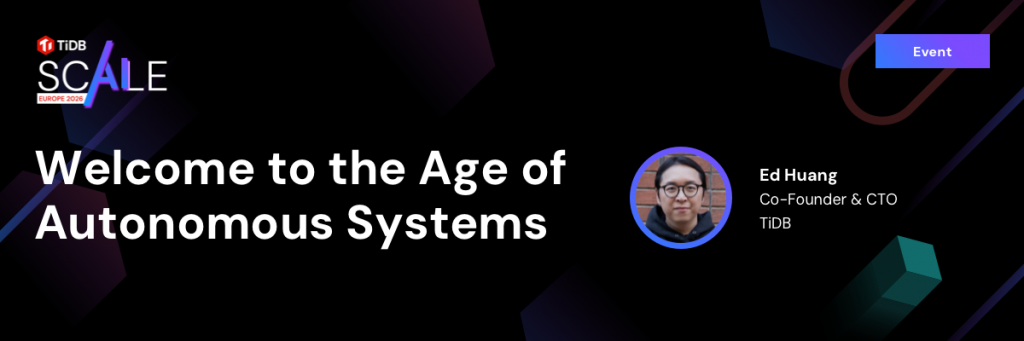
Ed Huang, Co-Founder and CTO of TiDB, opens the event with “Welcome to the Age of Autonomous Systems.” His keynote frames the larger shift behind the conference: Software is moving from applications that respond to users toward systems that plan, execute, collaborate, and improve through agent behavior.
That shift changes infrastructure assumptions. A traditional application issues a predictable set of queries for a user workflow. An agentic system branches across many intermediate decisions, retrieves context repeatedly, updates state, and validates results before returning anything useful. The database layer has to support that behavior without turning every application into a distributed systems project.
For architects and engineering leaders, the keynote sets the stage for the rest of the day. The next database evaluation is not only about scale. It is about whether the data layer can support how AI-native software runs.
LHV Bank and Bolt Bring Production Lessons from the Front Lines
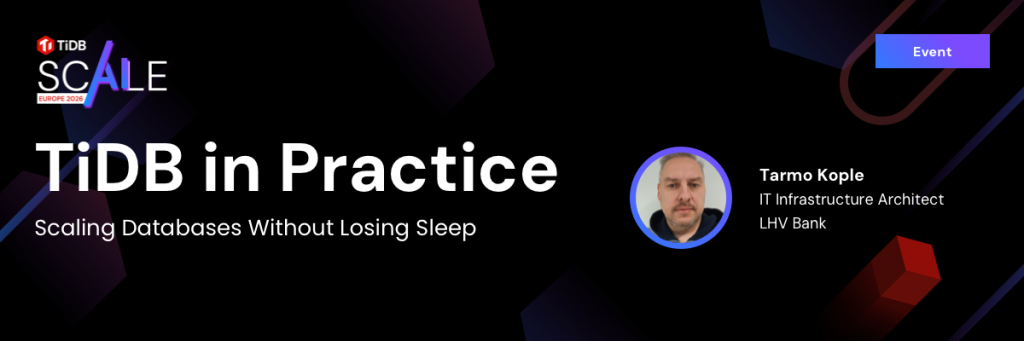
Tarmo Kople, IT Infrastructure Architect at LHV Bank and formerly Bolt’s DB Team Lead, brings a strong contrast to the agenda. His session, “TiDB in Practice: Scaling Databases Without Losing Sleep,” covers TiDB adoption across two very different environments: High-growth startup infrastructure and regulated banking.
That pairing matters. Startups and banks stress systems in different ways. A mobility platform pushes growth, elasticity, operational speed, and service availability across many markets. A bank pushes governance, control, reliability, and change management. One practitioner connecting those environments helps teams separate what is generally true about distributed SQL from what depends on organizational context.
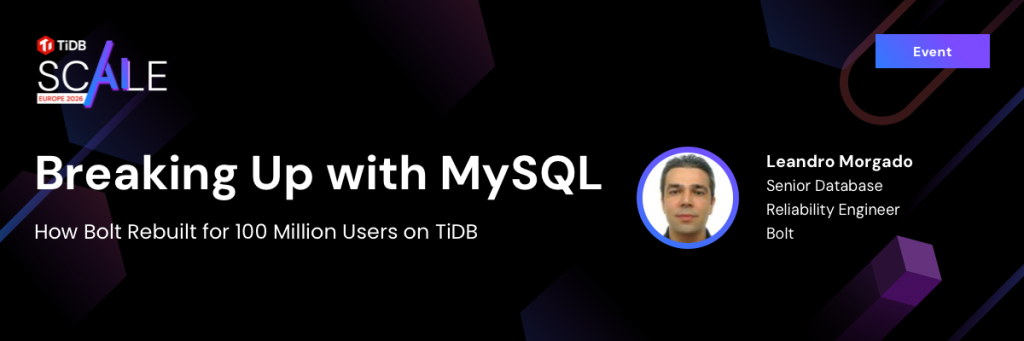
Bolt’s story continues with Leandro Morgado, Senior Database Reliability Engineer at Bolt. His session, “Breaking Up with MySQL: How Bolt Rebuilt for 100 Million Users on TiDB,” addresses a familiar scaling pattern: MySQL works well until operational friction starts to dominate engineering time. Bolt’s environment included 100 million users, 500+ cities, hundreds of schemas, thousands of microservices, and schema changes that could take up to a week on loaded 1 TB tables.
This is not migration as an abstract modernization project. It is the operational reality that pushes teams beyond a single MySQL deployment, the evaluation criteria Bolt applied to alternatives, and the path that moved critical workloads to TiDB clusters on AWS.
TiDB Engineers Take On Vectors, Migrations, and Agent Memory
Three TiDB technical sessions focus on the architecture questions teams face once they move from AI prototypes to production systems.
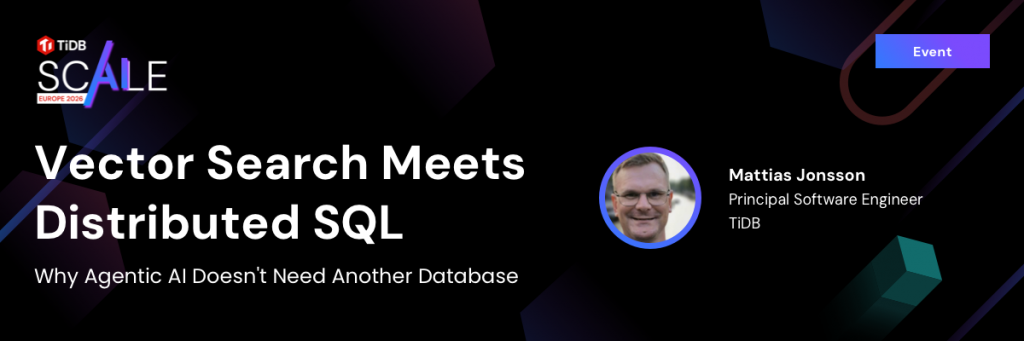
Mattias Jonsson, Principal Software Engineer at TiDB, presents “Vector Search Meets Distributed SQL: Why Agentic AI Doesn’t Need Another Database.” The session takes aim at a common pattern in AI application stacks: Adding a separate vector database beside the transactional system, then maintaining sync pipelines between them. For some teams that separation is justified. For others, native vector search inside distributed SQL reduces operational surface area and keeps retrieval closer to the data agents already need.
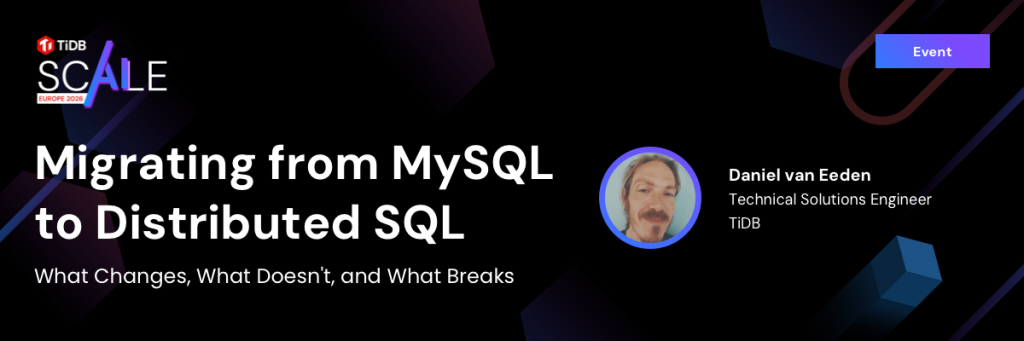
Daniël van Eeden, Technical Solutions Engineer at TiDB, covers “Migrating from MySQL to Distributed SQL: What Changes, What Doesn’t, and What Breaks.” Compatibility is not binary, and migration risk rarely shows up cleanly in a checklist. The session walks through which MySQL assumptions transfer cleanly, which ones need testing, and how distributed internals such as Raft consensus and LSM trees affect real workloads.
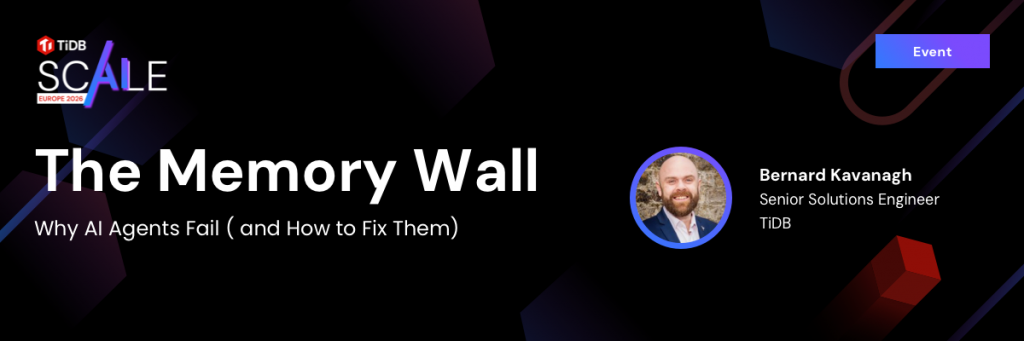
Bernard Kavanagh, Principal Solutions Architect at TiDB, presents “The Memory Wall: Why AI Agents Fail (And How to Fix Them).” The session targets a practical agent architecture problem: Separate systems for transactions, analytics, and vectors create brittle pipelines and state drift. Bernard introduces a converged architecture for persistent agent memory, including the Decide-Validate-Remember loop for reducing token costs and scaling multi-agent workflows.
Zilliz Shows What Vector Search is Doing
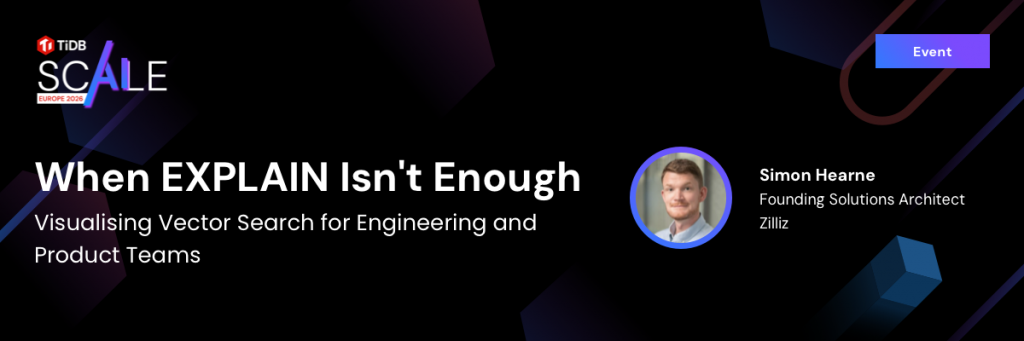
Simon Hearne, Founding Solutions Architect at Zilliz, closes a visibility gap in AI infrastructure: Vector search is hard to inspect. SQL teams have decades of habits around EXPLAIN, query plans, indexes, and execution diagnostics. Vector search introduces embeddings, approximate nearest neighbor indexes, quantization, and recall tradeoffs that many teams still struggle to reason about.
His session, “When EXPLAIN Isn’t Enough: Visualising Vector Search for Engineering and Product Teams,” gives engineering and product teams a clearer mental model for retrieval behavior. That matters because agent quality often fails quietly. Results degrade before dashboards show a clean outage.
Scania, AWS, and Ververica on Orchestration, Ops, and Streaming
Three more sessions round out the agenda: A hands-on look at multi-agent orchestration, agents inside SaaS operations, and streaming as the data layer beneath real-time agents.
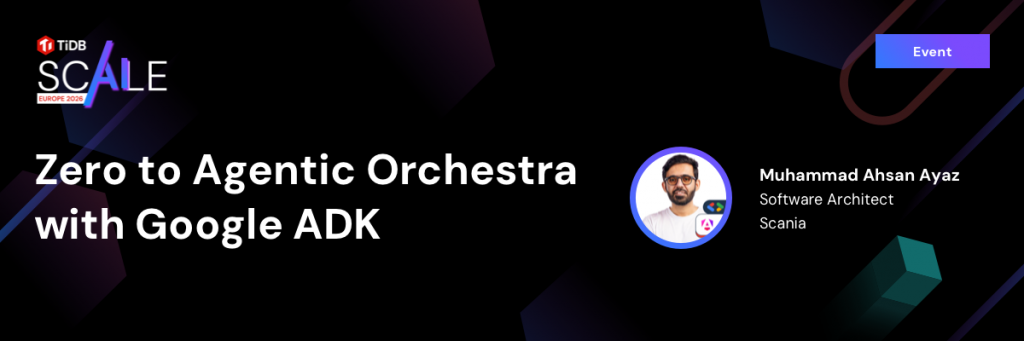
Muhammad Ahsan Ayaz, Software Architect at Scania Group, presents “Zero to Agentic Orchestra with Google ADK.” The session targets a familiar gap: Most AI agents are a single LLM wrapped in a system prompt, they work in demos, and they collapse in production. The fix is specialized agents that coordinate, each armed with MCP tools to act on the real world. The live-coding walkthrough builds a multi-agent system using Google’s ADK and MCP servers in Python, covering three orchestration patterns (sequential, parallel, iterative) and the separation between ADK’s control flow and MCP’s per-agent capabilities.
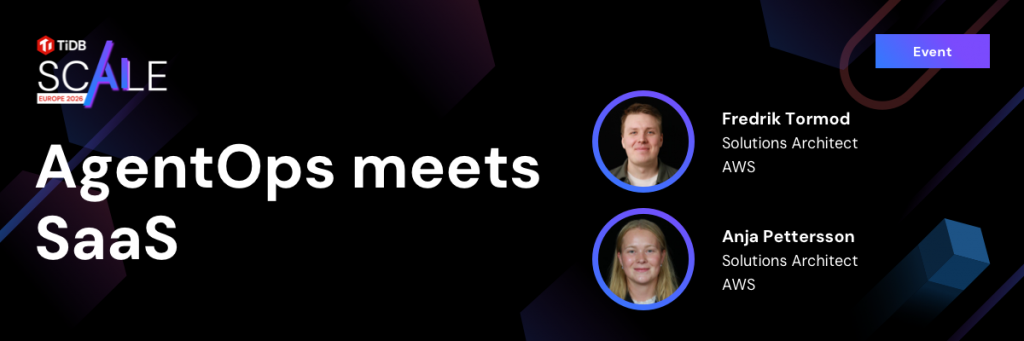
Fredrik Tormod and Anja Pettersson, both Solutions Architects at AWS, present “AgentOps meets SaaS.” Agentic patterns are common in the SDLC, especially code generation, and increasingly in product features. This session focuses on a third, less-explored dimension: Agents running inside the operations of a SaaS itself. The argument is that vendors who get agentic operations right first build a margin advantage competitors will struggle to match, and that AgentOps as a discipline is still early.
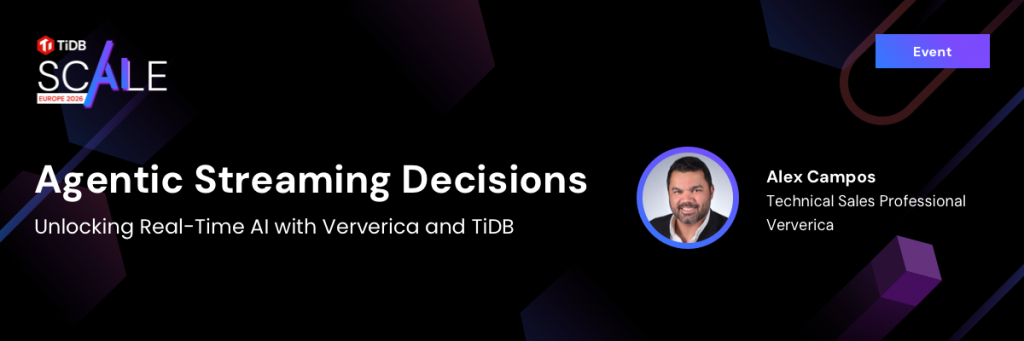
Alex Campos, Technical Sales Professional at Ververica, presents “Agentic Streaming Decisions: Unlocking Real-Time AI with Ververica and TiDB.” Agents in production need more than an LLM. They need fresh data, trusted context, durable memory, and the ability to act the moment business events happen. This session walks through how Ververica, powered by Apache Flink, processes live events and triggers decisions while TiDB provides the operational, analytical, and vector-aware data layer for context, retrieval, and agent memory. The pattern shows how streaming analytics can layer onto an existing enterprise data ecosystem instead of replacing it.
Register for TiDB SCaiLE Europe 2026
TiDB SCaiLE Europe 2026 is for teams that need database architecture to hold up under agentic AI, high-concurrency applications, and production migration pressure. The agenda centers on production migrations, agent memory architecture, vector search diagnostics, and MySQL-to-distributed-SQL workloads at the scale of Bolt and LHV Bank.
Join the sessions in Stockholm on June 4 and hear directly from the engineers, architects, and practitioners doing this work in production.
Experience modern data infrastructure firsthand.

TiDB Cloud Dedicated
A fully-managed cloud DBaaS for predictable workloads
TiDB Cloud Starter
A fully-managed cloud DBaaS for auto-scaling workloads